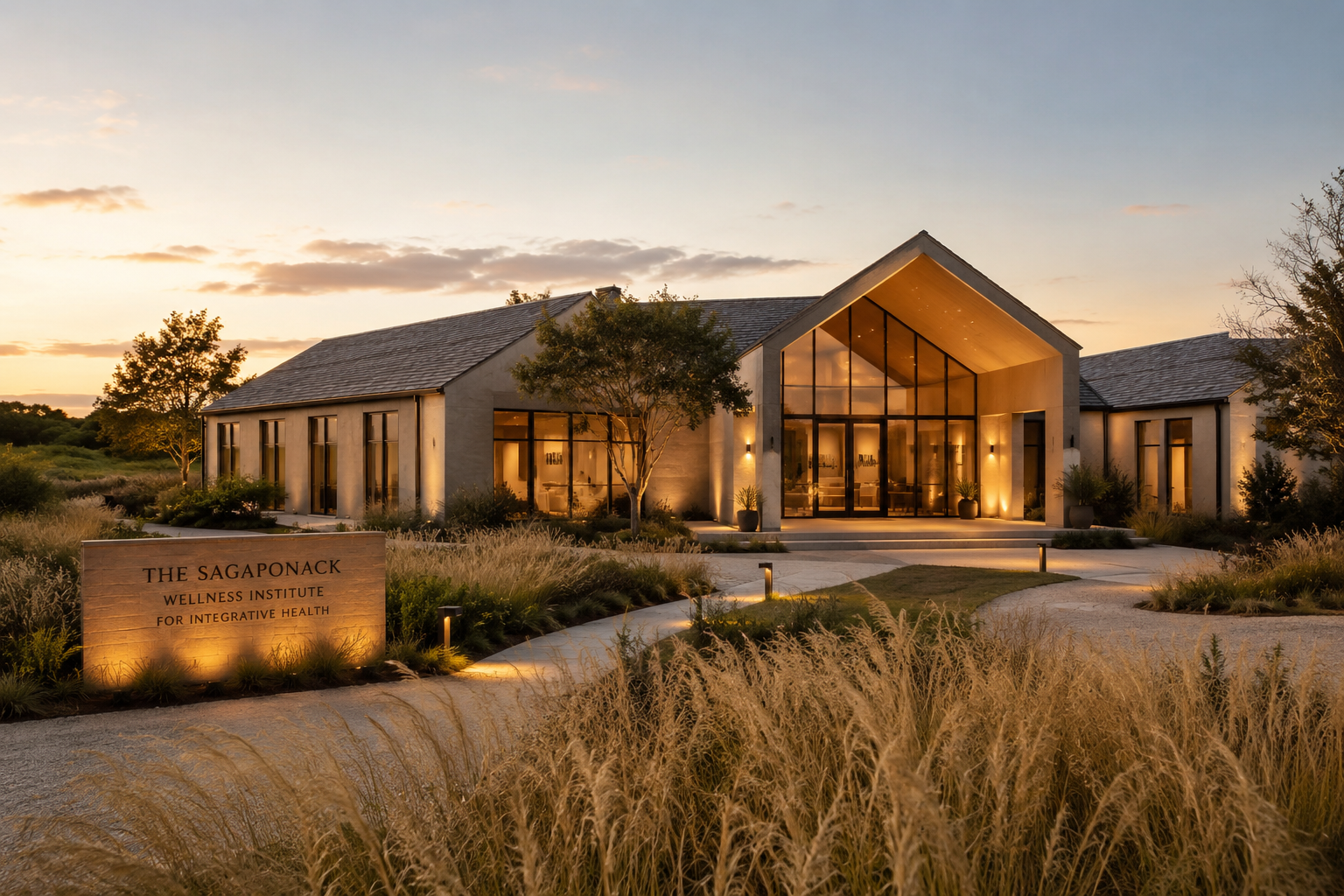
A New Kind of Hospital Opening in Sagaponack
AND IT MAY CHANGE WELLNESS CULTURE FOREVER
There’s a new luxury quietly sweeping through the Hamptons, Manhattan, Palm Beach, Aspen and Bel Air — and it isn’t a handbag, a boat, or a membership club.
It’s bloodwork.
Not the routine annual panel your internist glances at for six and a half minutes before recommending a statin and gently reminding you to “reduce stress.” No, this is the new world of optimized health: sprawling biomarker panels, peptide protocols, NAD drips, continuous glucose monitors discreetly hidden beneath cashmere sleeves, and conversations about T3 conversion discussed over lunch at Sant Ambroeus with the seriousness once reserved for hedge funds and schools.
Somewhere along the way, patients stopped believing their doctors were actually looking at them.
And can one blame them?
Modern medicine — brilliant in emergency rooms, lifesaving in trauma, extraordinary in surgery — has somehow become oddly uninterested in the grey space between “alive” and “well.” You can arrive exhausted, inflamed, foggy, gaining weight despite Pilates and green juice, sleeping poorly, unable to focus, and be told, almost mechanically, that everything is “within normal range.”
Normal according to whom, exactly?
Most laboratory ranges are derived from broad population averages — a population, it should be noted, that is hardly thriving. Functional medicine circles have become obsessed with this distinction: the difference between “normal” and optimal. It’s why two practitioners can look at the same thyroid panel and come to entirely different conclusions. One sees acceptable numbers. The other sees a patient whose body has been whispering for years that something is wrong.
This is, perhaps, why companies like Function Health, Marek Health, and Bryan Johnson’s Blueprint have become the new status symbols of the biologically ambitious. For under the price of a facial at the Carlyle, one can now order extensive laboratory testing, analyze inflammatory markers, hormones, ferritin, ApoB, fasting insulin, vitamin deficiencies and thyroid conversion patterns — all without waiting three months for an endocrinologist who may or may not spend longer with you than your barista does discussing oat milk.
And then, of course, there’s AI — the slightly terrifying new member of the care team.
People are now uploading labs into AI platforms and asking questions once reserved for expensive concierge physicians: Why is my ferritin elevated? Could low T3 explain my fatigue?
Why do I feel terrible if my labs are “normal”? What would functional medicine say about this?
The answers are not always perfect. Nor should AI replace physicians. But what these platforms offer — immediately, endlessly, without condescension — is curiosity. And right now, curiosity may be the single thing patients feel is missing most from modern healthcare.
Ten-minute appointments. Symptoms flattened into billing codes. Antidepressants handed out with alarming efficiency while root causes remain untouched somewhere beneath the surface like a leak behind a limestone wall. Cholesterol? Statin. Anxiety? SSRI. Fatigue? Stress. Weight gain? HORMONES. WHICH HORMONES?
One begins to wonder when exactly medicine became so… transactional.
Of course, there are extraordinary doctors. There always will be. The East End itself is evolving rapidly. The new Stony Brook Hospital Emergency FACILITY IN EAST HAMPTON feels positively futuristic by Hamptons standards — sparkling, efficient, and refreshingly responsive during the off-season. Weill Cornell continues its migration eastward. Cancer centers are expanding. Specialty care is improving.
And yet, what remains oddly absent is a true center for investigative, preventative, deeply personalized medicine.
Not wellness theater. Not cryotherapy and celery juice masquerading as science. Something real. A place where physicians actually sit long enough to study the orchestra of the body instead of merely silencing whichever instrument is currently playing too loudly.
Because this is ultimately what’s driving the peptide boom, the supplement stacks, the private longevity clinics and the late-night Reddit rabbit holes. It is not vanity, at least not entirely. It is the growing suspicion that if patients do not advocate for themselves, nobody else will.
So people experiment.
Magnesium. Taurine. NAD. GUT REPAIR. CRONOMETER AND YUKA APPS. MUSHROOMS. Glucose monitors. Methylation protocols. Ice baths. Infrared saunas. Adaptogens arriving in tiny amber bottles from compounding pharmacies with names that sound faintly Swiss.
Some of it is intelligent. Some of it is absurd. Some of it is likely dangerous. But desperation has always been an extraordinarily profitable market. Especially when people stop trusting the institutions meant to care for them. And perhaps one day, somewhere between Sag Harbor and Bridgehampton, someone will finally build it.
Not another whitewashed “wellness concept” draped in bleached oak and eucalyptus steam. Not a vanity longevity club where exhausted financiers compare peptide stacks beside an infrared sauna while pretending cold plunges are personality traits. Not a concierge practice charging five figures annually simply for the privilege of texting a doctor who still only gives you eleven minutes of their attention.
Something quieter. Smarter. More human.
Imagine arriving at a low-slung modern building tucked discreetly behind tall privet hedges off Montauk Highway. Gravel crunches beneath tires. The scent of salt air drifts through the parking court. Inside, there are no televisions screaming pharmaceutical commercials into the waiting room. No frantic fluorescent energy. No conveyor belt of patients being shuffled room to room like luggage at JFK.
Instead, there is time.
Real time.
A physician sits with you for ninety minutes and studies not merely your lab ranges, but your life. Your sleep. Your stress. Your inflammation. Your hormones. Your gut. Your nervous system. Your environment. Your history. Your patterns. The orchestra.
No one rushes to medicate before asking why.
Yes, there are nutritionists and proper diagnostic testing and perhaps even an infrared sauna tucked somewhere into the lower level overlooking a small zen garden. But the smoothies are secondary. The supplements are secondary. The aesthetic is secondary.The medicine comes first.
Imagine a place where conventional medicine and functional medicine stop ACTING like divorced parents fighting at a school recital and finally begin speaking to one another. A place where an endocrinologist, cardiologist, neurologist and nutrition expert actually collaborate rather than operate like isolated kingdoms connected only by fax machines and insurance codes.
Because the East End has no shortage of wealth. We build sprawling modern compounds with underground spas and wine cellars larger than Manhattan apartments. We spend fortunes optimizing our homes, our boats, our skin, our children’s tennis swings and our imported Italian kitchens.
And yet somehow, when it comes to our actual health, we still find ourselves racing to Provisions Natural Foods Market for the latest bottle of flushing niacin and advice from the resident supplement savant standing beside the magnesium aisle.Surely we can do better than that.
Surely one of the wealthiest stretches of coastline in America can create a place where medicine slows down long enough to remember the patient sitting in front of it.
Not optimized. Not biohacked. Not merely kept alive.
Now the only question is: who’s finally going to step up and open the Wellness Hospital In Sagaponack?